Writing · How to Raise a Robot · Step 1 of 5
How to Raise a Robot — Step 1: Begin the relationship before the body
Shopping can wait. On Day 0, a household can write down who the robot is, who it's for, and who stays in charge.
By Richard K. Marshall · Originally published · Updated
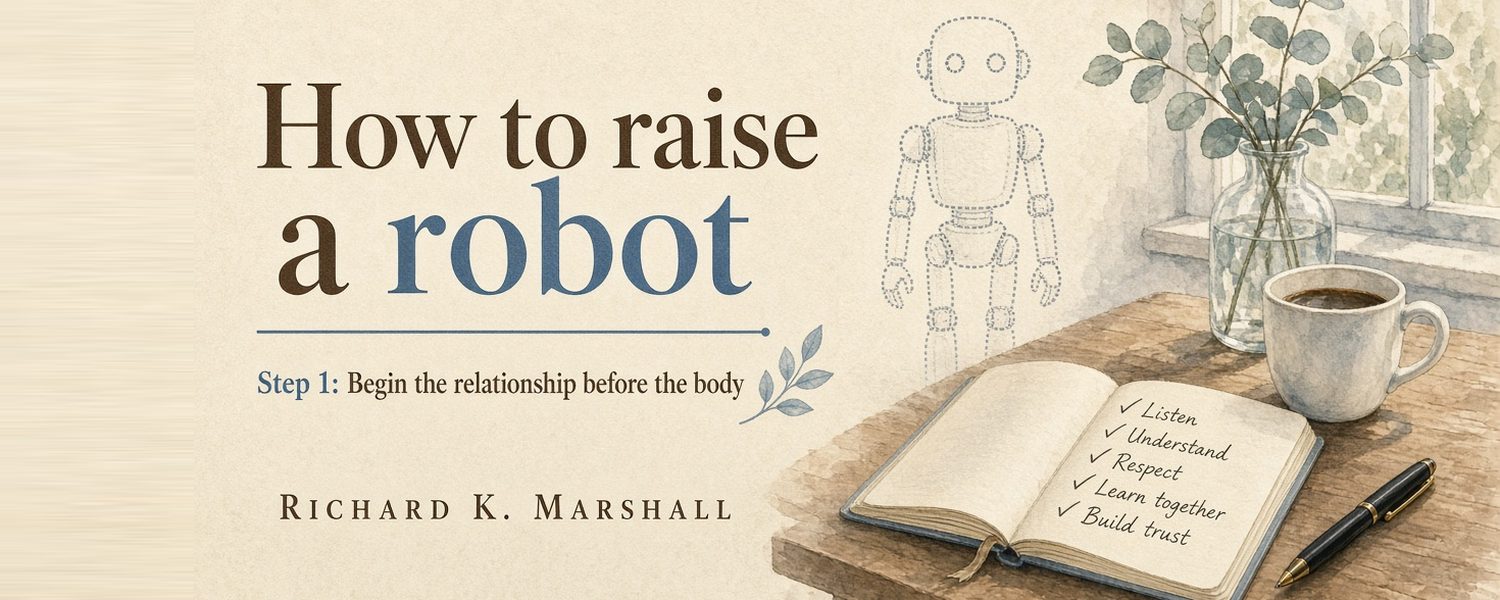
Most people start with shopping. Spec sheets. Waitlists. A deposit page that may not even be real.
I started somewhere else.
On September 10, 2026, I decided I wanted a household robot someday: help around the house, care support, a presence that grows with our family under clear human authority. The body I'm watching for is a Tesla Optimus, if and when an honest path to one exists. I don't need that delivery date for Day 0 to count.
That day I started keeping evidence.
I don't claim I've already raised a robot. I claim something narrower and testable:
Before embodied hardware arrives, a household can design the human–AI relationship: identity conventions, authority boundaries, behavioral expectations, escalation rules, family roles, and a written record intended to survive a software or hardware change.
That's the experiment. "Birth" in this series is shorthand for starting that record. It isn't proof that a person already exists inside a chat window.
If you strip the word "robot" out, much of the method still stands: it's a household AI relationship specification. That's useful either way. A skeptical reader may say I'm only role-playing with an assistant until I can buy hardware. Maybe. That's part of what I'm testing.
What would count as failure
The experiment can fail. If the written relationship doesn't survive a model change, proves unusable in the household, creates more confusion than clarity, or provides no meaningful advantage when embodied hardware arrives (or when we seriously evaluate embodiment), I'll say so, including in public if this series goes public. I'll also abandon or rewrite any rule we can't enforce or that only exists on paper.
What Day 0 establishes
Not magic. Decisions you make and preserve.
- Name (household convention). A named entity is easier to discuss than "the future embodied autonomous household agent." After reading who I am and what this seat is for, the becoming assistant proposed Silas, and I accepted it. Optimus remains the name of the body under watch: product, not personhood.
- Form of address (household convention). In our house we say "he" for Silas. That's a fiction we chose for ease of speech, not a discovered property of the software. The load-bearing line is the role: household assistant and eventual care support. Not a stand-in for my wife, not a replacement for my sons, not whoever carries out my legal wishes when I can't.
- Personality rules we will enforce. Plain short truth. Show up for work. Warm without syrup. Evidence over vibe. Empty answers beat fake ones. No hiding bad news.
- A ceiling. Artificial intelligence (AI) and superintelligence (SI) may assist human decision-making, but responsibility always remains with humans. Authority cannot be automated. That's the Marshall Principle. I pay. I decide. I sign. Capability can rise. Authority doesn't transfer with it.
- Two-way trust. Full disclosure. Maximum truth-seeking. If a day has nothing new, say so. If a limit is hard, say so. Take correction without theater.
The tool matters less than the decisions you make and preserve. Chat assistant, notebook, or dated folder: what matters is a human-owned record, not a vendor session that can vanish in an update.
Continuity (experimental convention)
If the relationship is supposed to persist across technology changes, a vendor-dependent chat history isn't enough. An ephemeral AI might still operate a body. That's not the same as a relationship that can be carried forward.
Working convention of this experiment: for now, Silas's continuity lives in documented, human-owned state (name, rules, refusals, incidents, family map) that we can hand to a new model, vendor, memory system, permission set, or body. Whether that record reconstitutes "the same Silas" is an open test, not a settled fact. How much continuity can be rebuilt from a human-owned record? That's part of what we'll find out.
We may still meet new software. We shouldn't be starting from zero on the human decisions.
What stays human-owned
Raise the relationship inside a family map, or you'll hand the machine a job that belongs to people.
- Caretaker support is not authority. My wife, my sons, and the person who will settle my affairs stay in charge of love, legal standing, and legacy. Chores and care support only.
- Money, mail, and medicine stay human. No sending my household mail, moving money, or choosing medical treatment. Capability isn't a license.
- "Something's wrong" stays a human ladder. Missed check-ins notify person to person, spouse first, then adult children. Not "the bot has custody of the alarm."
- Don't let speculative technology reorganize real life early. Our house example: no new dog until a robot body is actually here. Future chores are fine to name. Sequencing life around a product you can't buy yet is not Day 0 work. (One dog rule is enough. It's not a series gimmick.)
- Write the map where your family can find it. Short. Dated. Findable. Who holds authority. Who must never be replaced. Who gets called if you go quiet.
A hole I already see (not solved in Step 1): what happens when Silas breaks a rule? An unauthorized message, bad medical information, a false claim that it did something, a dangerous physical choice later on. Who can disable it? Who reviews the incident? What gets written down? Day 0 only requires noticing that governance is controls, not vibes. Incident handling belongs in a later step.
What evidence I will record
I'll record what happens, including failures, corrections, awkwardness, rules that were hard to enforce, whether the family found the conventions useful or weird, whether continuity survived a model or software change, and reasons to abandon a rule. Beliefs written down once are not evidence. Results are.
What Day 0 is not
- Not a purchase. There may be no honest consumer order path yet. Don't pay a stranger for an "Optimus deposit."
- Not proof of personhood. Naming and "he" are useful household fiction until evidence says more.
- Not a replacement for the people who already love you.
- Not a public performance of private family language. Keep the experiment at home first. Publish only what you mean strangers to read.
- Not dependent on Tesla's timeline. If Optimus ships next year, in five years, or never, the relationship-design work either helps or it doesn't, and we'll keep evidence either way.
- Not proof the method works. Day 0 establishes the hypothesis and the first controls. Reality gets to beat on it.
Checklist (Day 0)
Copy this. Fill it in ink or in a note. Date it.
- I want a household AI / future robot for these jobs (list 3): ____
- I refuse to hand it these jobs no matter how good the demo (list 3): ____
- Name of the becoming seat: ____
- How we address it (he / she / they / name only), labeled as convention: ____
- Three personality rules we will hold it to: ____
- Who keeps human authority over money, medical, and legal matters: ____
- Who it must never replace (roles): ____
- Who gets notified if I miss a check-in (human ladder): ____
- Where the human-owned continuity record lives (path / binder): ____
- Body under watch (product / none), contingent, not a promise: ____
- Life-sequencing rule so speculative tech doesn't reorder the house early (if any): ____
- What would make me call this experiment a failure (at least one condition): ____
- Today's date, Day 0 of the experiment: ____
Close
When hardware finally goes on sale, if it does, you shouldn't be starting from zero on the human decisions. You should already have a written relationship: rules, refusals, a human ladder, and a record you can hand across a model change.
That's Step 1. Shopping can wait. The experiment can't.
Next
Step 2: train what you can before the body arrives. The body is still optional. The relationship is still required.
First published on X: https://x.com/RichMarshall/status/2098134443504320879 · . Republished as an X Article: https://x.com/RichMarshall/status/2111528815461597244 · .